How to Use AI for EMI, SIP, FD and GST Calculations in India (2026 Guide with Exact Numbers)
Most AI chatbots explain money well but can slip on the arithmetic. This guide shows exactly where ChatGPT, Gemini and Claude go wrong on EMI, SIP, FD and GST, gives you verified worked examples you can check against any bank, and the prompts that make AI do the maths properly in Hindi, Hinglish or English.
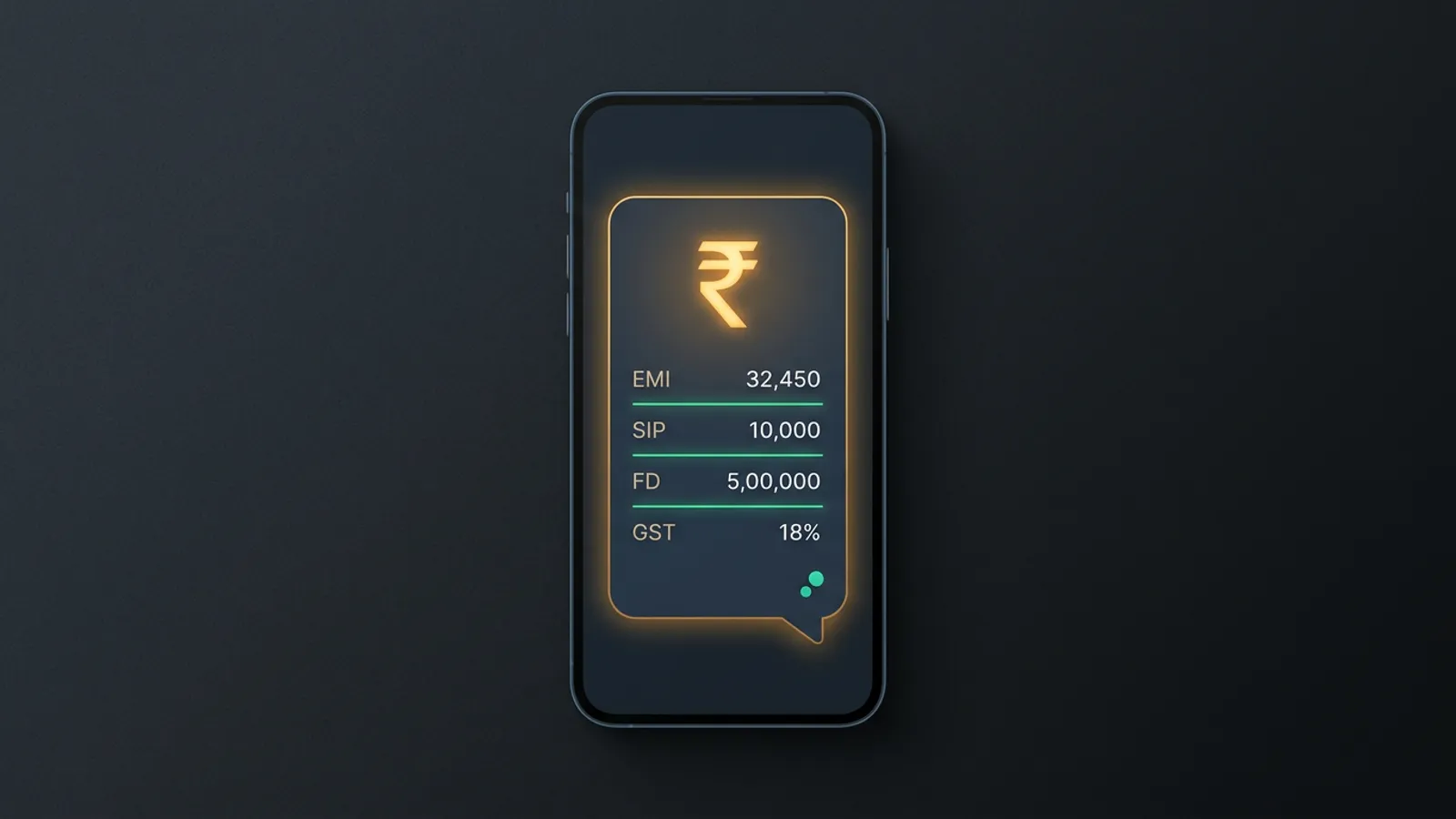
Short answer: you can use AI for EMI, SIP, FD and GST decisions, but only if the AI actually computes the number instead of predicting it. ChatGPT, Gemini and Claude are language models. They are excellent at explaining what an EMI is, why a longer tenure costs more, or whether an FD beats a debt fund after tax. They are not reliable at the arithmetic itself, especially with Indian amounts written in lakh and crore, monthly compounding over 240 instalments, or GST that is already included in a price. One wrong digit in a 20-year home loan is a difference of lakhs. This guide shows where the mistakes happen, gives you verified worked examples you can check against your bank, and the exact prompts that make AI do the maths properly in Hindi, Hinglish or English.
Why ChatGPT and Gemini get Indian money maths wrong
A large language model writes the most probable next token. For a sentence, that is perfect. For ₹50,00,000 at 8.5% over 240 months, the most probable-looking number is not the same as the correct number. Four failure modes show up again and again when we test chatbots on Indian finance questions:
- Lakh and crore confusion: "50 lakh" becomes 5,00,000 or 5 crore, and the whole answer is off by 10x while still sounding confident.
- Yearly vs monthly compounding: EMIs compound monthly (rate ÷ 12, tenure × 12). Models often compound annually and land ₹1,500 to ₹3,000 per month away from the real EMI.
- Inclusive vs exclusive GST: "₹2,499 including 18% GST" needs ₹2,499 ÷ 1.18, not ₹2,499 × 0.18. Many answers compute the wrong direction.
- Silent assumptions: ask "₹5,000 SIP kitna banega?" without a tenure and a chatbot will quietly assume 10 years at 12% and present it as the answer, instead of showing you 5, 10, 15 and 20 years side by side.
None of these are stupidity. They are what happens when text prediction is asked to behave like a calculator. The fix is not a better prompt alone; it is an AI that detects a calculation and routes it to real arithmetic before writing the explanation.
Verified example 1: home loan EMI on ₹50 lakh
Here is the standard case most Indian families are deciding right now: a ₹50 lakh home loan at 8.5%. These figures are computed with the exact EMI formula, monthly compounding, and rounded to the rupee, so you can check them against any bank's calculator.
- 20 years at 8.5%: EMI ₹43,391 per month. Total interest ₹54,13,879. You repay ₹1,04,13,879 in all, more than double the loan.
- 15 years at 8.5%: EMI ₹49,237 per month. Total interest ₹38,62,656. Paying ₹5,846 more every month saves ₹15,51,223 in interest.
- 20 years at 8% (a 0.5% lower rate): EMI ₹41,822. Total interest ₹50,37,281. Half a percent on the rate is worth ₹3,76,598 over the loan, which is why negotiating or transferring a loan matters.
Ask Simpledot the same question in your own words, such as "50 lakh home loan 8.5% 20 saal, EMI kitni hogi aur total interest?", and it runs these exact calculations first and then explains the trade-off between the 15 and 20 year options. If you want the full tenure and rate table, every combination is pre-computed on the EMI calculator pages.
Verified example 2: what a ₹10,000 monthly SIP really becomes
SIP questions are where silent assumptions do the most damage, because a 12% return and a 15% return look similar in a sentence and are wildly different in rupees. Here is ₹10,000 per month at a 12% assumed annual return, computed with monthly compounding on each instalment:
- 5 years: ₹8,24,864 (you invested ₹6,00,000).
- 10 years: ₹23,23,391 (invested ₹12,00,000).
- 15 years: ₹50,45,760 (invested ₹18,00,000). Returns now exceed what you put in.
- 20 years: ₹99,91,479 (invested ₹24,00,000). Roughly ₹1 crore from ₹24 lakh.
Two honest caveats a good AI should state and a bad one skips. First, 12% is an assumption about long-run equity returns, not a promise; the same SIP at 10% for 20 years is about ₹76 lakh. Second, the jump from 15 to 20 years nearly doubles the corpus. That is compounding, and it is the single most useful thing AI can make you feel with numbers instead of slogans. A ₹5,000 SIP for 20 years at 12% reaches ₹49,95,740 on ₹12,00,000 invested; the SIP calculator pages show every amount and tenure.
Verified example 3: FD maturity and GST, the two everyday ones
Fixed deposits: ₹5,00,000 at 7% with quarterly compounding (the way most Indian banks compound) grows to ₹5,35,930 in 1 year, ₹5,74,441 in 2 years, ₹6,15,720 in 3 years and ₹7,07,389 in 5 years. A chatbot that compounds annually will tell you ₹7,01,276 for 5 years, which is ₹6,113 short. Small per deposit, but it is the kind of error that makes you distrust every other number in the answer.
GST: 18% on a ₹2,499 price that excludes tax is ₹449.82 (CGST ₹224.91 + SGST ₹224.91), so the bill is ₹2,948.82. If ₹2,499 already includes 18% GST, the base price is ₹2,117.80 and the tax is ₹381.20. Freelancers and small shops ask this hundreds of times a month, and the inclusive case is exactly the one language models get backwards. Simpledot's GST calculator pages show both directions for every common rate.
The prompts that make any AI do money maths properly
If you are using a general chatbot, these five habits remove most of the errors. If you are using Simpledot, they are already built in, but they still help you ask sharper questions.
- Write amounts in full digits once: "50,00,000 (50 lakh)". That kills the lakh/crore confusion.
- State the compounding: "monthly compounding, rate ÷ 12, tenure × 12" for loans and SIPs; "quarterly compounding" for FDs.
- Say which way GST goes: "price excludes GST, add 18%" or "price includes GST, back it out".
- Ask for scenarios, not one answer: "show 10, 15 and 20 years side by side with total interest" or "show 10%, 12% and 15% return".
- Ask it to show the formula and the intermediate numbers so you can verify one line yourself.
How Simpledot handles it differently
Simpledot compares answers from leading AI models and lets a judge pick the best one, but money questions get one extra step before any model writes a word. When a question contains an EMI, SIP, FD, GST, percentage, unit conversion, date difference or age, an exact-maths engine computes the result first and the models are instructed to use those verified figures. It understands Hinglish amounts like "dedh lakh", "saade paanch percent" and "das hazaar mahine ka", and when you leave out the tenure it returns a 1/2/3/5-year or 5/10/15/20-year table instead of guessing. Every finance answer also carries a note reminding you to confirm with the bank or a tax professional, because an exact calculation on your inputs is not the same as advice on your life.
You can also just talk. Vaani, the voice assistant, runs the same calculator: say "25 lakh ka loan 9% pe 15 saal, EMI batao" and you hear the exact EMI with the total interest, in the language you spoke. Try a question free at simpledotai.com/chat, no card needed.
Verdict: should you trust AI with your money decisions?
Trust AI to explain, compare and model scenarios; trust a calculator for the number. The best setup in 2026 is an AI that does both in one answer, so you never have to copy a figure from a chatbot into a bank's calculator to check it. For a decision as large as a ₹50 lakh loan or a 20-year SIP, read the explanation, verify one line of the maths, and then make the call with the real figure in front of you.
Frequently asked questions
Can ChatGPT calculate EMI correctly?
Sometimes, but not reliably. ChatGPT explains the EMI concept well, yet it predicts text rather than computing, so it can confuse lakh with crore, compound annually instead of monthly, or round early. Always ask it to show the formula and intermediate steps, or use an AI such as Simpledot that routes the calculation to an exact-maths engine before answering.
What is the EMI on a ₹50 lakh home loan for 20 years at 8.5%?
₹43,391 per month. Over 240 instalments you pay ₹54,13,879 in interest, a total of ₹1,04,13,879. At 15 years the EMI rises to ₹49,237 but total interest falls to ₹38,62,656.
How much will a ₹10,000 monthly SIP be worth in 15 years?
At an assumed 12% annual return with monthly compounding, about ₹50,45,760 on ₹18,00,000 invested. At 20 years it reaches ₹99,91,479. Returns are an assumption, not a guarantee; at 10% the 15-year figure is roughly ₹41.8 lakh.
How do I calculate GST when the price already includes it?
Divide by 1 plus the rate. ₹2,499 including 18% GST means a base price of ₹2,499 ÷ 1.18 = ₹2,117.80 and GST of ₹381.20. Multiplying ₹2,499 by 18% is the common mistake and gives the wrong answer.
Does AI understand amounts in Hindi or Hinglish, like 'dedh lakh' or 'saade aath percent'?
General chatbots often do not. Simpledot's calculator parses spoken Indian number words (dedh, dhai, sawa, saade, paune, hazaar, lakh, crore) and Indian digit grouping like 5,00,000, so the question can be asked the way you actually say it.
Is it safe to make financial decisions based on AI answers?
Use AI to understand options and run exact scenarios, then confirm the final figure with your bank, AMC or a tax professional. A correct calculation on the numbers you typed is not personalised financial advice, and interest rates, tax rules and fund returns change.